
The Marketing Revolution Is Here
What if I told you that the most successful marketing organizations of 2027 will look nothing like today’s teams?
While your competitors are still hiring more specialists and building bigger departments, a small group of forward-thinking companies are quietly building something entirely different. They’re creating marketing teams that deliver enterprise-level results with startup-level resources.
Just as the electric motor transformed manufacturing during the Industrial Revolution by enabling modular factory layouts and efficient assembly lines, AI is creating the opportunity to fundamentally reimagine how marketing teams function.
The traditional marketing department wasn’t designed for modern B2B marketing. Its specialized roles, coordination overhead, and scaling challenges can’t keep up with today’s speed and consistency requirements.
The Real Problem Isn’t Technology
Here’s what we’ve discovered working with companies implementing this transformation: the constraint isn’t the technology. The constraint is organizational thinking that’s stuck in pre-AI models.
Most marketing leaders are still trying to solve AI-era challenges with industrial-era solutions. They add more specialists. They create more processes. They build bigger teams.
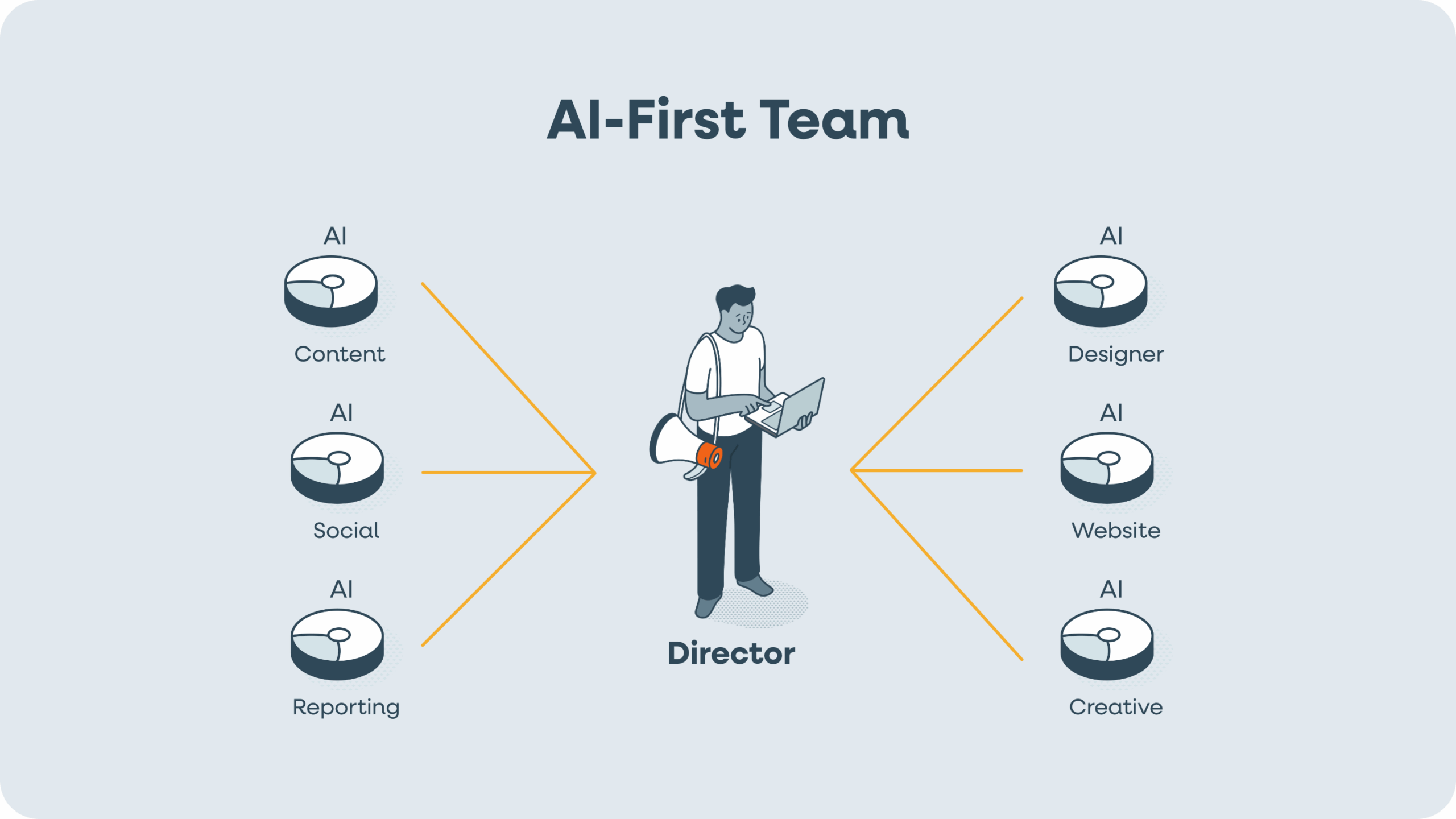
But the companies pulling ahead are doing something completely different. They’re building marketing organizations around AI amplification rather than human coordination.
The result?
Marketing directors who can orchestrate enterprise-level campaigns with startup-level resources while achieving consistency that traditional teams simply cannot match.
From Coordination Nightmare to Strategic Focus
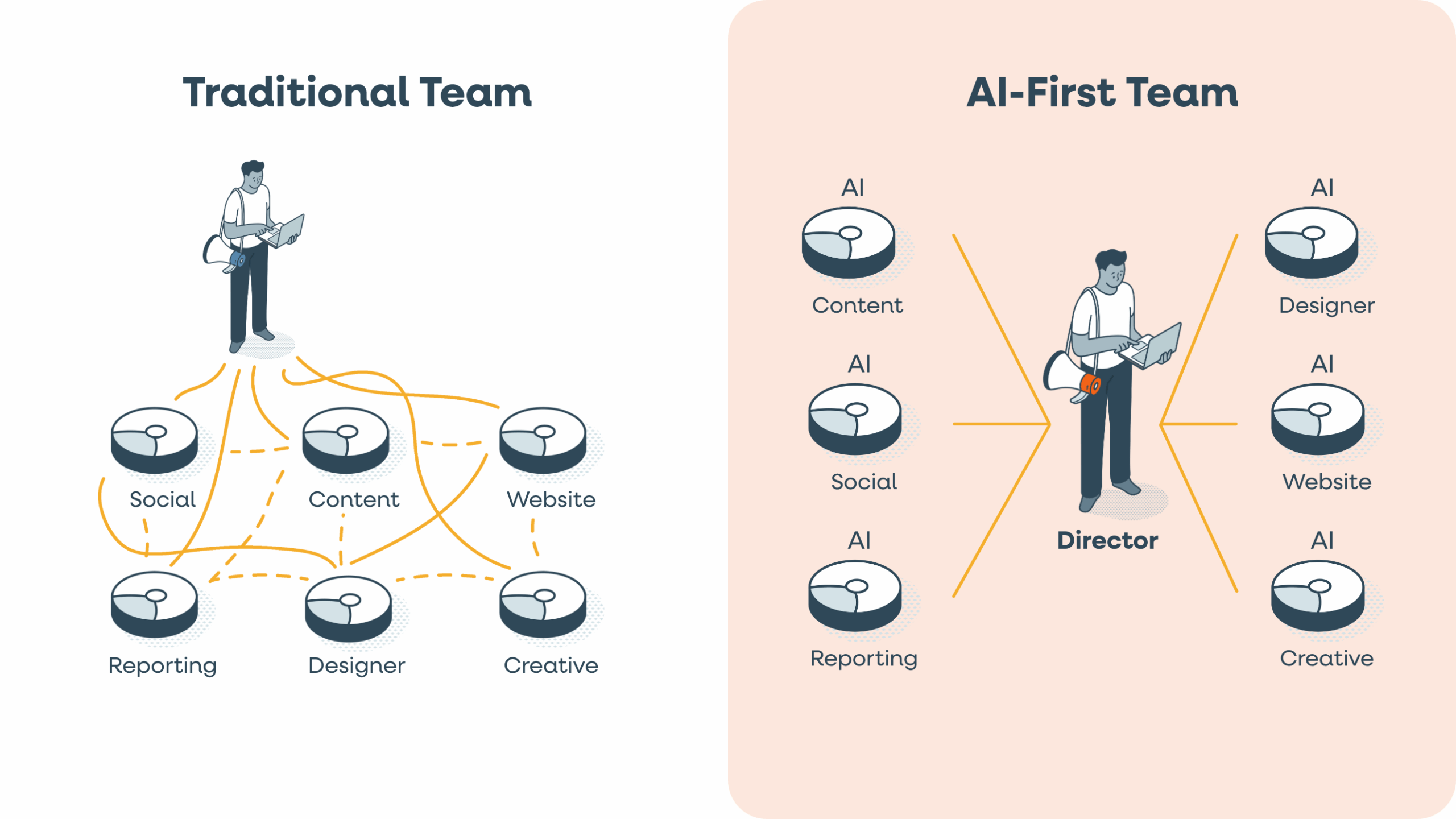
Traditional marketing teams face an invisible tax that undermines every initiative: coordination overhead.
Think about your last campaign launch. How much time was spent on internal alignment versus strategic thinking? How many revision cycles happened because team members interpreted the strategy differently?
The Hidden Math Problem
Here’s the math most marketing leaders miss: as team size increases, coordination complexity grows exponentially.
- A four-person marketing team has 6 communication paths
- Add two more people, and you suddenly have 15 paths
- Each path represents potential message drift, timeline delays, and quality inconsistencies
The AI-First Solution
The AI-First Marketing Team model eliminates this coordination tax entirely. Instead of managing human specialists who interpret strategy differently, you direct AI agents who execute from the same strategic foundation every time.
This isn’t about replacing human creativity. It’s about amplifying human strategy through perfectly consistent execution.
Case Study: From Four-Person Team to Strategic Powerhouse
Let me share how this played out for one of our consulting clients, a B2B software company serving the healthcare industry.
The Starting Point
When we started working together, they had a traditional four-person marketing team:
- Marketing director
- Content specialist
- Social media manager
- Email marketing coordinator
The Challenge
The challenges were familiar. Despite having dedicated specialists, their messaging was inconsistent across channels:
- The content specialist wrote blogs that emphasized technical features
- The social media manager focused on industry trends
- Email campaigns had a different tone entirely
- Prospects received mixed signals about what the company actually did and why it mattered
The Coordination Trap
Worse, the marketing director spent 70% of their time on internal coordination:
- Reviewing drafts
- Aligning messaging
- Managing deadlines
- Explaining strategy repeatedly
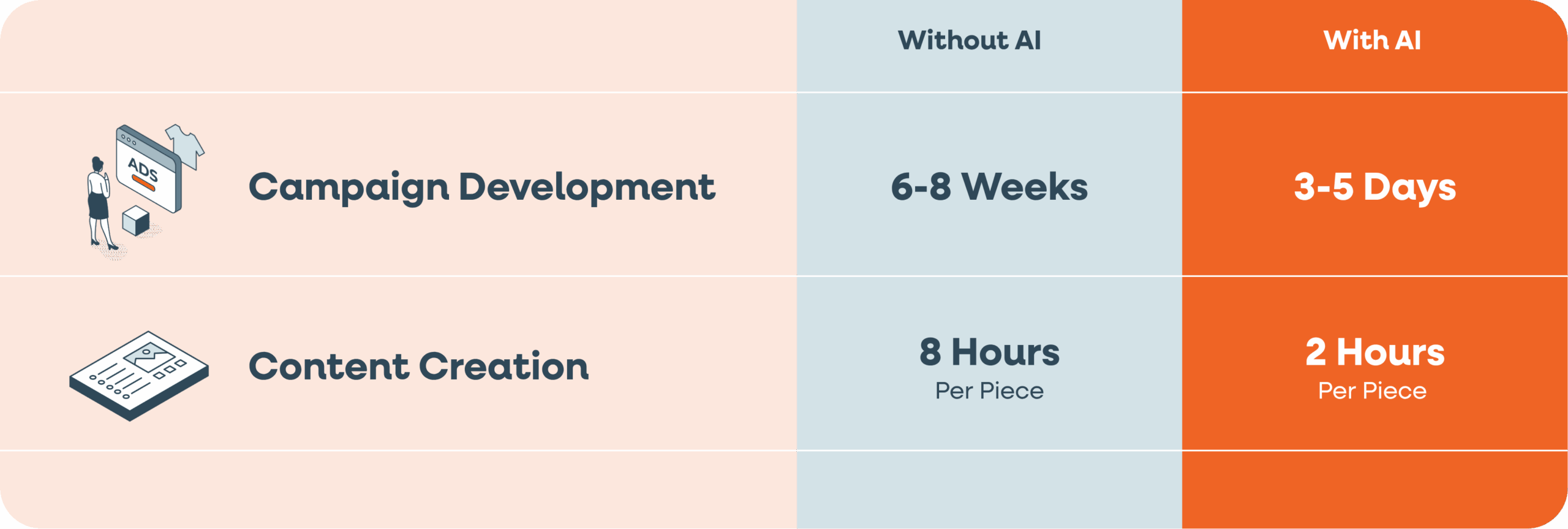
Campaign development took 6-8 weeks because every piece of content required multiple revision cycles to achieve basic consistency.
The Business Impact
The business impact was predictable:
- Longer sales cycles
- Confused prospects
- Constant pressure from the sales team about lead quality
The Solution
Working with ReturnOn, they implemented the AI-First Marketing Team model. Instead of managing human specialists through constant communication, their marketing director learned to direct AI agents.
This created the consistency and efficiency that had been impossible with traditional team coordination.
The Results: Strategic and Financial Transformation
The transformation delivered results that exceeded everyone’s expectations:
Time Savings
- Campaign development compressed from 6-8 weeks to 3-5 days
- Content creation accelerated from 8 hours per piece to 2 hours
- Marketing director’s strategic focus time increased from 30% to 75%
Quality and Consistency
- Brand consistency scores improved from 60% to 95% across all channels
- Message alignment between marketing and sales reached 100%
- Content quality remained high while production speed increased 300%
Business Impact
- Lead generation increased 40% within six months
- Lead quality improved significantly: sales reported prospects asking more specific, qualified questions
- Sales cycle length decreased 25% due to consistent trust-building across all touchpoints
The Unexpected Benefit
But here’s what surprised everyone most: the marketing director described the role transformation as “finally being able to do the job I was hired for.”
Instead of managing coordination problems, they were focused on competitive strategy, market analysis, and business growth initiatives.
The AI-First Marketing Director Model
This transformation created something unprecedented: a marketing director who functions more like a strategic conductor than a traditional manager.
Here’s how the role fundamentally changes:
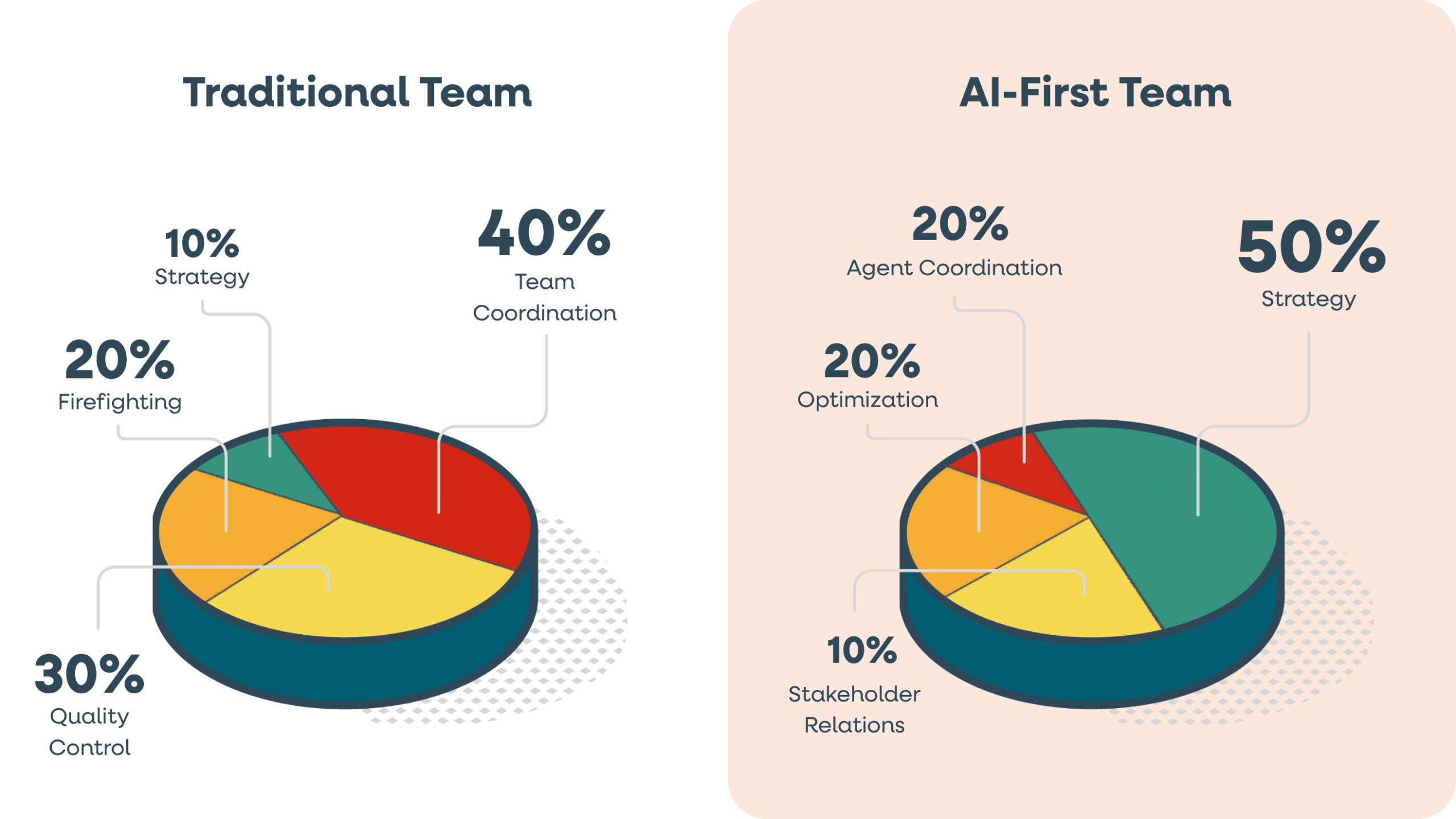
Traditional Marketing Director Time Allocation:
- 40% people management and coordination
- 30% quality control and revision oversight
- 20% tactical execution and firefighting
- 10% strategic planning and analysis
AI-First Marketing Director Time Allocation:
- 50% strategic planning and competitive analysis
- 20% performance analysis and optimization
- 10% stakeholder communication and relationship building
- 20% agent coordination and execution
This shift enables marketing directors to focus on what actually drives business results: understanding market dynamics, developing competitive strategies, and optimizing based on performance data.
Why This Model Creates Lasting Competitive Advantage
The companies implementing AI-First marketing teams aren’t just improving efficiency; they’re building competitive advantages that compound over time:
Speed Advantage:
While competitors spend weeks coordinating campaign launches, AI-First teams execute in days, capturing market opportunities faster and responding to competitive moves immediately.
Consistency Advantage:
Every customer touchpoint reinforces the same strategic positioning, building trust systematically while competitors struggle with message drift across teams and channels.
Resource Advantage:
Enterprise-level marketing capability without enterprise costs enables superior market coverage and higher-quality prospect experiences.
Learning Advantage:
AI agents incorporate feedback and optimization instantly across all activities, creating continuous improvement cycles that accelerate competitive differentiation.
Your Path to Transformation
The AI-First Marketing Team model represents more than operational improvement. It’s the foundation for a new kind of marketing organization that combines strategic thinking with systematic execution.
The Window Is Closing
Companies building this capability now will define tomorrow’s competitive landscape. Others will continue struggling with coordination overhead, inconsistent messaging, and scaling challenges that hiring more people cannot solve.
What It Takes
The transformation requires three things:
- Foundation-first thinking
- Systematic implementation
- Commitment to new organizational models
But for marketing leaders ready to move beyond traditional constraints, the opportunity to build sustainable competitive advantage has never been clearer.
Ready to Transform Your Marketing Organization?
If you’re experiencing any of these challenges, the AI-First Marketing Team model could transform your organization:
- Coordination overhead consuming your strategic focus
- Inconsistent messaging undermining your market position
- Struggling to scale marketing impact without proportional cost increases
How We Can Help
ReturnOn specializes in helping B2B companies implement this transformation. We’ve developed a proven four-pillar approach that enables marketing directors to achieve enterprise-level results through AI-powered consistency and strategic focus.
The Choice Is Yours
The marketing revolution is happening now. The only question is whether you’ll lead it or follow it.
In the next chapter, we’ll examine the critical mistakes that are quietly undermining businesses across entire industries…